
A Common Assumption Worth Challenging
When corn yields fall short, it’s easy to point to the usual suspects—weather, nitrogen rates, or hybrid performance. And while those all play a role, they usually aren’t the root cause. In many cases, the issue started much earlier, before the crop ever had a chance to reach its full potential.
In a recent article, we talked about how consistent yields come from managing variability, not just chasing top-end bushels. That idea starts with recognizing that not every acre behaves the same.
But there’s another layer to it. A lot of that variability is already set in the first 30–45 days of the season.
Where Variability Really Begins
By the time corn reaches V3 to V6, you can already start to see differences across a field. Some plants are taller, darker green and closing canopy faster (saturated environments), while others are clearly lagging behind (water-limited environments).
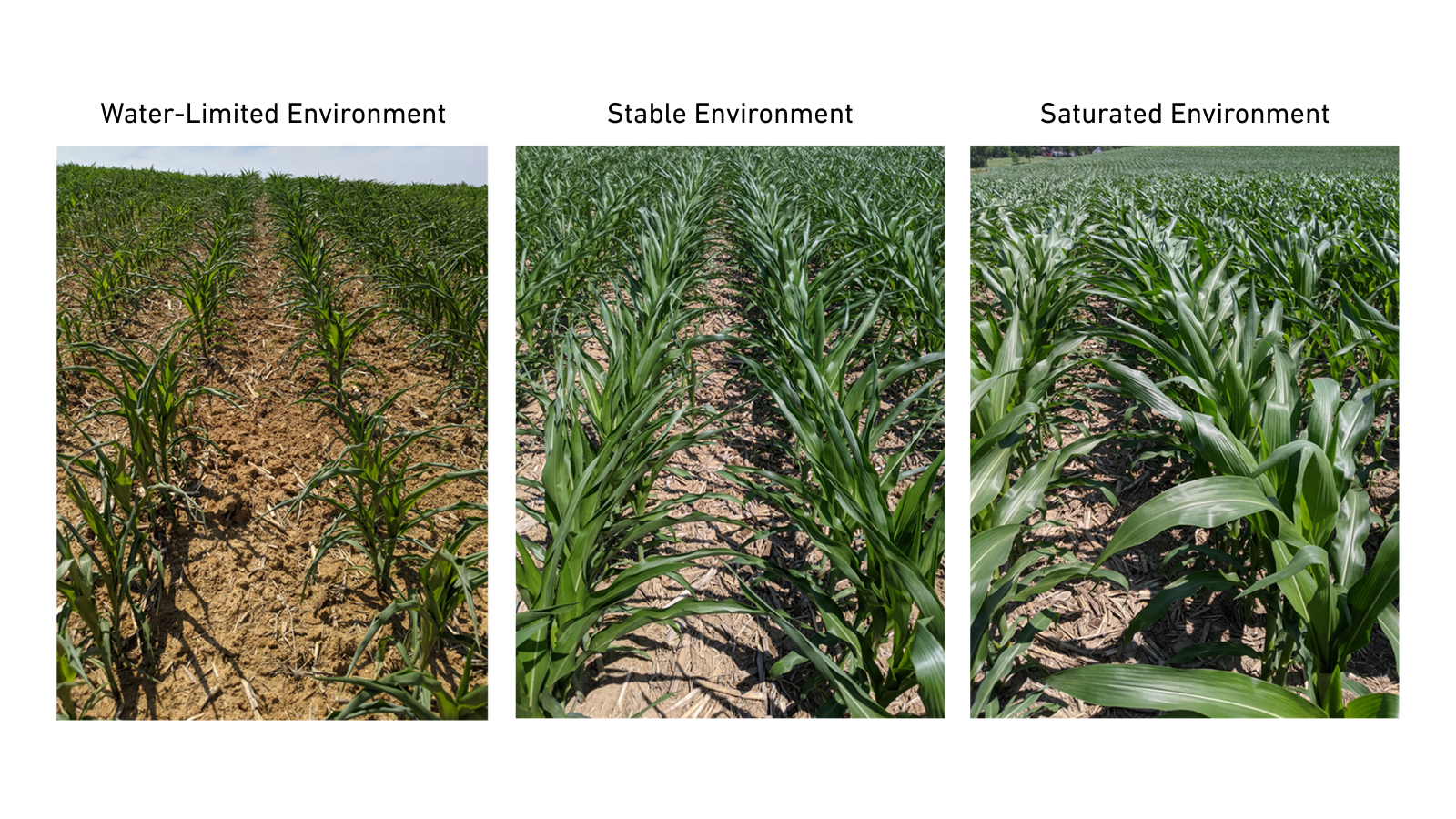
Early on, those differences might not seem like a big deal. But they ultimately set the direction for the rest of the season, and once that gap is there, it’s tough to close.
Not every part of a field has the same ability to support early growth. All fields have a mix of environments. Some areas are lighter and tend to dry out faster, often with lower organic matter. Others stay wetter and can struggle with oxygen and nutrient availability. And then there are areas that are simply more consistent year to year.
Each of these environments responds differently, especially early in the season.
Why Some Plants Never Catch Up
Lower organic matter means less nitrogen being supplied early. Drier soils make it harder for nutrients to reach the roots. Cooler or wetter conditions can slow development.
Put all of that together, and it becomes clear why some plants get off to a strong start while others never quite catch up.
When a plant falls behind early, it’s not just smaller—it’s working with less. It captures less sunlight, stores less energy, and is more vulnerable when stress shows up later in the season.
A timely rain or a stretch of good weather can help, but it rarely erases that early disadvantage. That’s where variability really starts to show up at harvest, with wider swings in yield, a lower floor, and less predictability across the field.
Why Nitrogen Isn’t the Whole Story
Nitrogen is usually the first thing we look at when trying to fix these problems. The challenge is that applying the same rate across every acre assumes every acre responds the same way—and that’s almost never the case.
Some areas already have enough early-season nutrient availability and won’t respond much to more. Other areas are limited early and need more support just to build plant mass.
The issue isn’t always how much nitrogen you apply. It’s whether it’s actually helping the crop where it needs it, when it needs it.
The Real Opportunity
If early plant development is what drives yield consistency, then the goal becomes pretty straightforward: reduce the gap between your best acres and your toughest acres, and do it early in the season.
That means putting more focus on the areas that struggle to get started, while avoiding overinvesting in areas that are already set up to perform.
When more plants reach V6 at a similar size and level of vigor, everything becomes more consistent. Yield stabilizes, risk goes down, and performance becomes more predictable from year to year.
Most yield challenges don’t start at tassel, or even mid-season—they start early. The more evenly you can support plant development in those first 30–45 days, the more consistent your results will be at harvest.
Want to talk through what this looks like on your farm?
Every field is different. If you’d like to take a closer look at how variability is showing up in your acres—and what you can do about it—our agronomy team is here to help.