
How early-season plant growth and managing field variability lead to more predictable farm profitability
As growers make final agronomic decisions ahead of planting, it’s natural to think about maximizing yield potential. Every corn and soybean grower knows the thrill and satisfaction of harvesting a record-breaking field. But in today’s unstable agricultural economy, filled with volatile markets, unpredictable weather, and eye-popping input costs, record yields aren’t the metric that keeps an operation stable.
Consistency is what allows you to build a farming operation that will survive turbulent market conditions.
Across thousands of acres and multiple seasons, the growers who succeed aren’t the ones who push one field to the max. The ones who are truly successful are those who understand what drives variability, combat the factors limiting yield, and produce more crops that perform reliably, year after year.
That shift in mindset—from chasing the thrill of “once in a lifetime” record yields to building predictable performance—creates real economic advantage. But creating that crop resilience, which translates to economic stability, starts much earlier in the season than most people think.
Why Early Growth Predicts Long-Term Success
Corn doesn’t wait until tassel to reveal its potential. Much of its productivity is determined before the plant is even knee-high, which means many of the decisions that influence yield are made well before or during planting.
Early vegetative growth is directly tied to how efficiently the plant captures sunlight, produces energy, and builds sucrose, the fuel that keeps it vigorous and allows it to tolerate stress more effectively.
As described in an earlier article, Understanding the Growth Equation, plants with greater leaf area at V6 capture more light, produce more energy, grow faster, and store more sucrose for later stress events. And that early advantage shows up at harvest time.
Figure 1: The Importance of Early Vegetative Plant Mass (VPM)
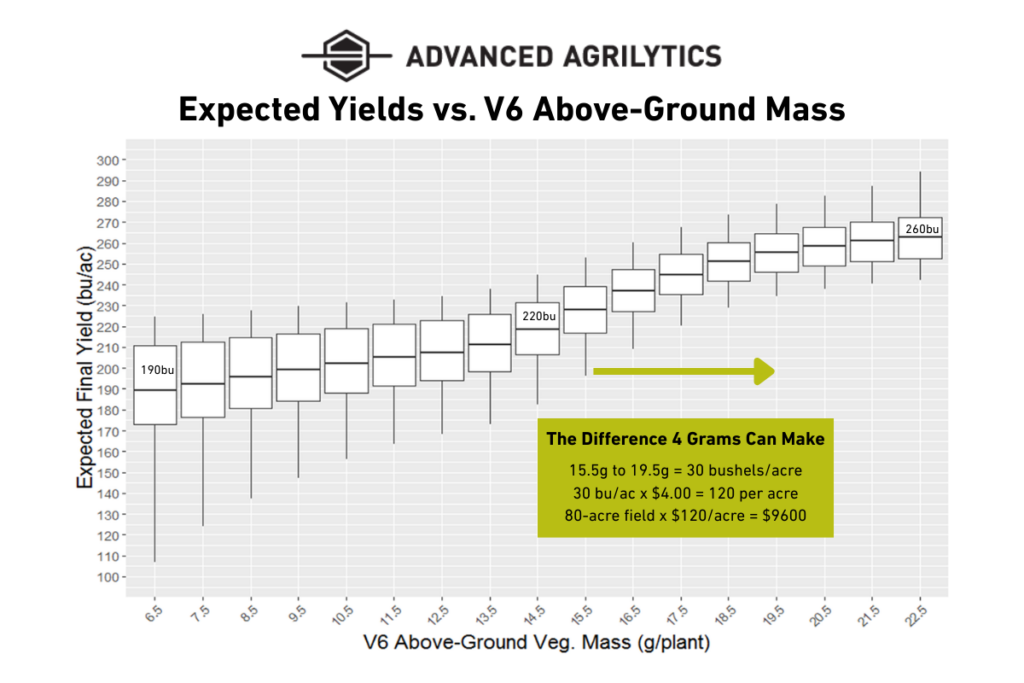
At $4 per bushel, that equals a yield and profit bonus of $120 per acre. For an 80-acre field, that’s $9,600 in lost yield for the underweight plant.
What else does this chart tell us?
In addition to explaining the relationship between V6 plant mass and expected final yield, it shows that setting up young plants for strong early growth actually lowers risk. Think of crop resilience as your best risk management strategy.
Smaller VPM = longer whiskers (red box)
This means more downside risk. Plants that are behind at V6 show far more variability in their final yield. Some may recover, but many don’t. In addition, these smaller plants cope less effectively with stresses such as heat or disease than larger, stronger plants.
Larger VPM = shorter whiskers (blue box)
Bigger plants not only produce higher expected yields, they do it more consistently. The risk of poor performance drops sharply, and the upside potential increases.
When plant growth at V6 becomes more consistent, good things happen:
- Yield distribution tightens
- Downside risk decreases
- ROI becomes more predictable
- Your ability to make confident operational decisions grows
In plain language:
The earlier a plant gets established, the more stable and predictable its performance becomes. That stability compounds across systems, fields, and seasons. Reducing volatility isn’t just good agronomy; it’s a smart business strategy.
What Causes Corn Yield Variability Across a Field?
Most growers can point to their “good” acres and the “frustrating” ones. But it’s the hidden variability within those acres, like differences in soil moisture, nitrogen loss, slope, and organic matter, that drives corn yield variability and creates uneven early growth.
Traditional “cookie-cutter” agronomic management often widens the yield gap.
For example:
Low-lying ground prone to early saturation may lose nitrogen through denitrification, starving young plants. High, water-limited ground may have enough nitrogen but not enough moisture to move phosphorus and potassium into the root zone.
Some areas achieve canopy closure early, while others lag behind and lose energy to respiration.
These environmental differences directly impact early vegetative mass, and therefore yield consistency, long before the season’s major weather events arrive.
That’s why Advanced Agrilytics focuses on understanding each sub-acre environment, its limitations, and its opportunities. Our spatial agronomy analysis examines soil wetness, slope, nitrogen loss potential, and nutrient diffusion potential to guide decisions at a sub-acre scale.
The result: stronger, more vigorous plants by the V6 growth stage.
And as every grower knows, every season eventually throws its curveballs.
Crop Resilience Creates Better Yield Consistency
Weather volatility isn’t going away. But healthier, more resilient plants are more likely to handle the stress challenges a growing season brings.
Advanced Agrilytics customer data shows that:
- Growers using spatial nitrogen management experience flatter yield-decline curves during stressful weather years than regional crop insurance benchmarks.
- Advanced Agrilytics customers saw an average 25 bu/acre improvement over county averages after eight to ten years using our analytical and agronomic management practices.
- Yield in their traditionally poor-performing acres improved more than 30 bu/acre.
Figure 2: Corn ROI Results with Advanced Agrilytics’ Management
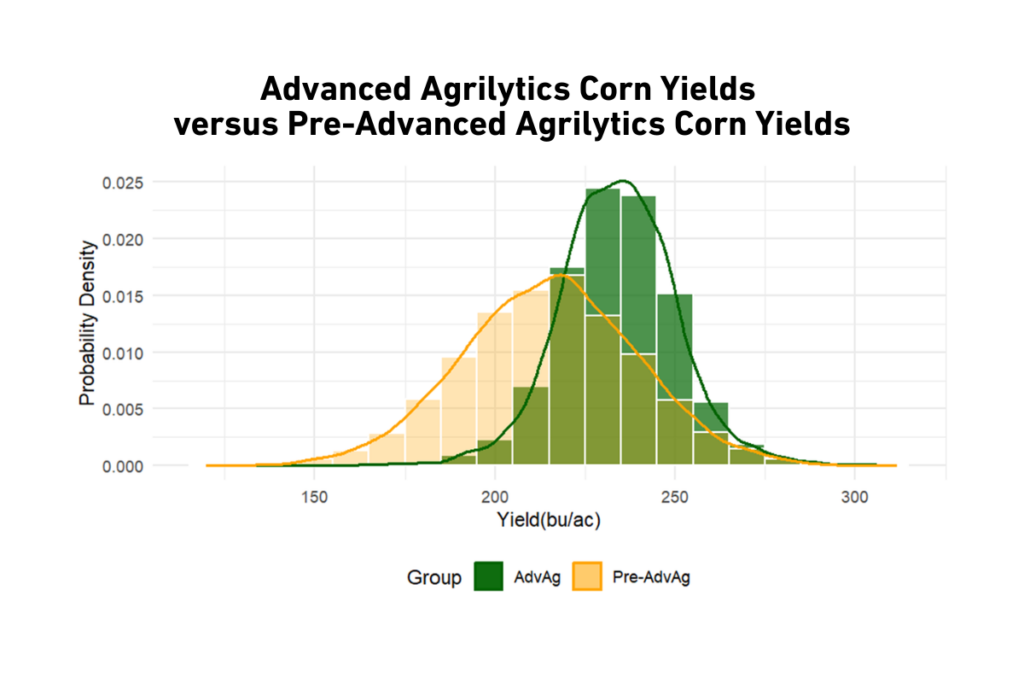
The graphic shows a significant rightward shift in yield distribution after implementing Advanced Agrilytics management.
In addition, there was a substantial reduction in the left tail of the distribution, indicating that production improved significantly on traditionally poor-producing acres.
The Power of Repeating Success, Not Just Chasing It
Record yields are exciting, but not very repeatable.
What’s far more sustainable is a holistic approach focused on achieving more consistent yield outcomes across every acre.
If you want to break the “peaks and valleys” yield cycle and start building a more resilient, predictable operation, start with early growth:
- Evaluate your V6 variability: Are plants uniform? Are some acres habitually behind?
- Identify the sub-acre environments behind that variability. Water-limited and saturated environments can exist feet apart and require different strategies.
- Tailor nitrogen, seeding, and fertility decisions to each environment. Small early differences create large harvest outcomes.
- Focus on building vegetative plant mass early. Even a few grams difference at V6 can shift your farm’s overall production potential.
The Bottom Line: Consistency Protects Your Operation’s Future
Growers who invest in understanding variability—and managing it early—build stronger, more resilient operations that perform well in both good years and tough ones.
If you’re ready to take the next step toward more predictable performance this season and beyond, the Advanced Agrilytics team is here to help you understand what’s happening within your acres and guide you toward more reliable outcomes.