


In our previous posts, we explored how predictive agronomy helps improve nitrogen efficiency and why that efficiency drives profitability. In this article, we look at another important side of the story: how better nitrogen use efficiency (NUE) supports environmental stewardship, reduces nitrogen loss, and contributes to long-term sustainability at the farm level.
What Is Nitrogen Use Efficiency?
Nitrogen use efficiency, or NUE, describes how effectively a crop converts available nitrogen into harvested yield. In corn production, it is commonly evaluated by comparing grain yield with the amount of nitrogen available or applied. Higher NUE means more of the nitrogen investment contributes to crop production and less is vulnerable to environmental loss.
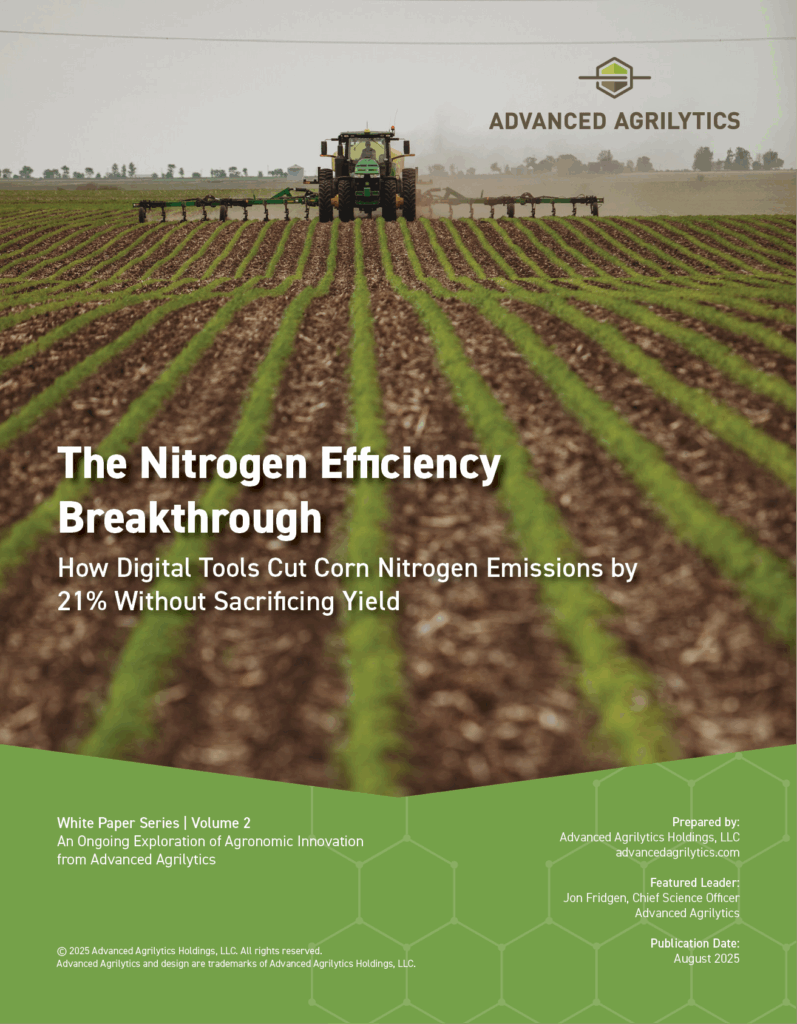
Dig Into the Sustainability Findings
This article draws from The Nitrogen Efficiency Breakthrough white paper, where we measured how improved nitrogen efficiency cuts carbon intensity and reduces N₂O emissions. Read the full research to see how smarter nitrogen use supports both productivity and stewardship.
How Nitrogen Use Efficiency Works in Crop Production
Nitrogen use efficiency can be evaluated in several ways depending on the purpose of the analysis. A straightforward farm-level measurement compares crop yield with the amount of nitrogen applied:
Nitrogen use efficiency = crop yield ÷ nitrogen applied
For example, corn growers may evaluate how many bushels were produced for each pound of applied nitrogen. Agronomists may also use more detailed measurements that account for nitrogen supplied by the soil, nitrogen taken up by the crop, or the difference between fertilized and unfertilized areas.
Because soil-supplied nitrogen and growing conditions differ across a field, NUE should not be interpreted as a single universal target. It is most useful when evaluated alongside yield, soil characteristics, weather, nitrogen timing, placement, and the crop’s actual access to nitrogen.
Why Nitrogen Use Efficiency Matters for Corn Growers
Improving NUE helps growers get more productive value from their nitrogen investment while reducing the amount vulnerable to leaching, volatilization, runoff, or denitrification. It can support stronger yield performance, better input efficiency, improved profitability, and more responsible environmental management.
The objective is not simply to apply less nitrogen. The objective is to place the appropriate amount where and when the crop can use it most effectively.
How Predictive Agronomy Improves Nitrogen Use Efficiency
Predictive agronomy evaluates how soil texture, elevation, moisture, organic matter, temperature, and other field conditions influence nitrogen supply, movement, loss risk, and crop uptake.
Instead of treating every acre the same, this approach identifies different growing environments within a field and adjusts nitrogen rate, timing, placement, and concentration accordingly. This helps prevent nitrogen shortages in environments with greater crop requirements while limiting unnecessary applications where the soil may already supply more nitrogen.
Nitrogen Efficiency and Environmental Stewardship Go Hand in Hand
For many growers, environmental sustainability can feel like a buzzword that does not always fit the reality of production agriculture. But at its core, it is about making the most of every input, especially nitrogen.
When nitrogen is applied more precisely and used more efficiently, less escapes into the air or leaches through the soil. That means cleaner water, healthier soil, and fewer greenhouse gas emissions.
Efficiency is not about applying less nitrogen overall. It is about applying where and when it will have the greatest impact for the crop, minimizing what is lost to the environment.
What the Data Shows: Efficiency Reduces Loss and Emissions
In The Nitrogen Efficiency Breakthrough white paper, we analyzed NUE across more than 750,000 acres of corn and quantified its impact on emissions and carbon intensity.
The findings were clear. Improving nitrogen efficiency led to a 23.5 percent reduction in carbon intensity and a 21 percent decrease in nitrous oxide (N₂O) emissions per bushel of corn produced.
Those improvements matter because nitrous oxide is nearly 300 times more potent than carbon dioxide as a greenhouse gas. Every pound of nitrogen kept in the field, instead of lost to volatilization or leaching, helps reduce agriculture’s overall carbon footprint.

Why Prediction is Key to Environmental Gains
Nitrogen loss is not just about how much is applied but about how it behaves across different soil and weather conditions. Predictive agronomy uses spatial data to anticipate these variations before the season begins.
By modeling how soil texture, slope, and moisture interact with nitrogen, we can predict where losses are most likely to occur and adjust rates, placement, and timing accordingly. This approach minimizes nitrogen runoff and volatilization while maintaining yield performance.
That is the difference between reactive and predictive management — preventing loss instead of responding to it.

Efficient Nitrogen Use Strengthens Soil Health
Beyond emissions, efficient nitrogen management also supports soil health. Overapplication and surface losses can alter soil chemistry, lower pH, and disrupt microbial activity.
Predictive agronomy maintains the soil’s natural balance by keeping nitrogen in the root zone longer and supports the microbial processes that drive nutrient cycling and organic matter retention. Over time, that leads to healthier, more resilient soils that are better equipped to handle changing weather patterns.
Efficiency as Everyday Stewardship
For growers, the environmental benefits of better NUE are not abstract. They show up in the form of cleaner tile water, improved soil structure, and stronger crop performance year after year.
By focusing on prediction instead of reaction, nitrogen efficiency becomes a practical way to protect both the operation’s productivity and the environment it depends on.
At Advanced Agrilytics, we believe that every efficiency gain is a win for both profitability and stewardship. The data proves that better management today builds a stronger foundation for tomorrow.
Frequently Asked Questions About Nitrogen Use Efficiency
What factors cause low nitrogen use efficiency?
Low nitrogen use efficiency can result when nitrogen availability does not align with crop demand. Common contributing factors include poorly timed applications, excessive or insufficient rates, limited root access, dry soil, saturated soil, runoff, leaching, volatilization, denitrification, compaction, soil variability, and differences in organic matter and mineralization.
Weather and field position also matter. A nitrogen strategy that performs well in one portion of a field may underperform in another because the two environments hold water, supply nitrogen, and support root development differently.
How can growers improve nitrogen use efficiency without sacrificing yield?
Growers can improve NUE by matching nitrogen management more closely to the needs and conditions of individual field environments. That may include adjusting nitrogen rate, timing, placement, source, concentration, or stabilization strategy based on soil characteristics, moisture patterns, crop demand and nitrogen-loss risk.
Improving NUE should not mean reducing nitrogen indiscriminately. A better strategy reallocates nitrogen—using less where the crop or soil does not require it and protecting or increasing availability where yield is most at risk.
How does predictive agronomy improve nitrogen use efficiency?
Predictive agronomy uses field data and agronomic modeling to anticipate where nitrogen will be supplied by the soil, where crop uptake may be limited, and where nitrogen is most vulnerable to loss. This allows nitrogen decisions to be made according to sub-acre growing environments rather than relying on one uniform rate across the entire field.
How does improved nitrogen use efficiency reduce nitrogen loss and emissions?
When more available nitrogen is taken up by the crop and converted into yield, less remains vulnerable to leaching, volatilization, runoff and denitrification. Reducing these losses can help protect water quality and decrease the amount of nitrous oxide released per unit of crop production.
Across more than 750,000 acres of corn analyzed by Advanced Agrilytics, improved nitrogen efficiency was associated with a 23.5% reduction in carbon intensity and approximately a 21% decrease in nitrous oxide emissions per bushel compared with the cited industry benchmarks.
Is applying less nitrogen the same as improving nitrogen use efficiency?
No. Applying less nitrogen may reduce input costs, but it does not necessarily improve NUE and could limit yield if the crop does not receive enough nitrogen in the environments where it is needed.
Improving NUE means increasing the productive value of available nitrogen. Depending on the field, that may involve reducing nitrogen in some areas, maintaining it in others, and increasing or better protecting it in environments with greater crop demand or loss risk.
Ready to See the Environmental Advantages on Your Acres?
Talk with one of our agronomy experts to learn how predictive nitrogen management can help improve efficiency, reduce losses, and strengthen your farm’s sustainability performance.